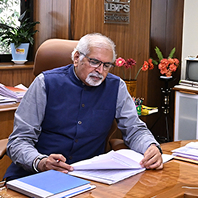
Vipin K Chilana is a Professor of Psychometrics and Advisor to the Client Relations Divisions of the Institute of Banking Personnel Selection (IBPS) based in Mumbai, India. He holds a Bachelor of Science (B.Sc.) from Rajasthan University, a Master of Arts (M.A.) in Psychology, with specializations in Psychometrics and Industrial Psychology, from Guru Nanak Dev University, and a Postgraduate Diploma (PG Dip) in Guidance, Educational and Vocational Guidance from Panjab University.
Professor Chilana describes his 45-year career journey, which began between 1981 and 1983 at the National Council of Educational Research and Training (NCERT) in Delhi, where he worked as a Project/Research Fellow on the development of the National Test Library and the Vocational Maturity Scale. He subsequently joined the National Institute of Public Cooperation and Child Development (NIPCCD), where he worked from 1983 to 1987. During this period, he gained experience in monitoring social welfare programs and broadened his understanding across areas including child welfare, women’s issues, and rural development.
In 1987, he joined IBPS in Mumbai as a Faculty Research Associate and subsequently progressed through the ranks to become the most senior faculty member, serving as Senior Professor and Advisor in the Senior Scale. He is currently the last man standing in the organization who has closely worked with its founders.
He explains that IBPS was established following the nationalization of India’s banks in 1969, which led to the establishment of the National Institute of Bank Management (NIBM). Within NIBM, a Personnel Selection Services (PSS) Unit was created to help design recruitment and promotion programs for banks. The unit was modelled after the Education Testing Service (ETS) in Princeton, but focused on recruitment rather than admission programs.
Professor Chilana explains that IBPS originally administered paper-based assessments but moved to a digital examination system to address issues of security and time constraints. The transition to online assessments began in 2006, scaling up to examinations becoming fully digital by 2014-2015. He also notes IBPS’ recent recognition as a Public Examination Authority by the Government of India.
He emphasizes the importance of aptitude tests over subject knowledge tests, viewing them as better predictors of job success, particularly since aptitude tests measure the individual’s ability to learn rather than their existing knowledge. He also discusses the adoption of objective tests, specifically multiple-choice questions (MCQs), as part of their assessment strategy. IBPS has a psychometric and assessment team of approximately 40 people, many of whom are responsible for multiple roles.
Professor Chilana explains that IBPS conducts approximately 500 different types of examinations annually, involving an average of 10 million candidates. Each examination session is limited to 100,000-150,000 candidates due to limited computer access across India. The examinations are conducted at designated centres using Local Area Network (LAN)-based systems, where question papers are downloaded to local servers before the Internet connection is disabled.
He identifies several key challenges, including the need for robust test equating when scaling up to more examination sessions, the requirement for higher-quality and more secure examination centres, and the prevention of examination malpractices.
Professor Chilana explains that IBPS monitors examination centres through a combination of on-site observers, a live examination command centre, system logs, response-pattern analysis, and post-examination data reviews. He describes different types of examination centres, ranging from dedicated Grade A testing centres owned by partner organizations, to shared centres at colleges and institutions that are used during specific examination periods.
Professor Chilana’s role at IBPS involves guiding operations including test development, test equating, and psychometrics. He also conducts training programs for interviewers and observers involved in group discussions. Through professional connections with company officials whom he has met at e-Assessment Association conferences, he is familiar with Vretta’s success in delivering digital assessment solutions in Canada and Europe.
Reflecting on his long career, Professor Chilana takes great satisfaction in his institute’s teamwork and its contributions to transforming the landscape of recruitment testing across India. He is particularly proud of IBPS’s transition to digital examinations, and its adoption and implementation of best practices in large-scale assessment. Having contributed to numerous innovations at IBPS, he is also recognised for his ability to identify unique patterns in data and emerging trends.
Away from his professional responsibilities, Professor Chilana enjoys creative writing, penning and sharing his experiences, photography, and music. During a recent visit to Montreal’s International Jazz Festival, he discovered a particular fascination for jazz music. Please feel free to reach out to Professor Chilana at: vchilana@ibps.in

