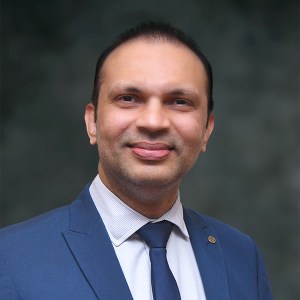
Dr. Naveed Yousuf is the Chief Executive Officer (CEO) of the Aga Khan University Examination Board (AKU EB) and Associate Professor of Practice in the Department for Educational Development, Faculty of Health Sciences (AKU). He holds a Bachelor of Medicine, Bachelor of Surgery (MBBS) from Sindh Medical College (now known as Jinnah Sindh Medical University); a Master of Business Administration (MBA) in Health Management and Human Resource Management from the Institute of Business Management (IoBM); an Advanced Diploma in Health Professions Education from Aga Khan University; a Fellowship in Medical Education from the University of Illinois Chicago (USA); and a Doctor of Philosophy (Ph.D.) in Medical Education from University Ambrosiana (Italy).
Dr. Yousuf describes his professional journey as an evolution from medicine to health professions education and eventually, to assessment and educational leadership. After beginning his career in clinical medicine and basic sciences, he joined Aga Khan University, where he progressed through academic and leadership roles in health professions education and assessment over nearly two decades. His work has encompassed curriculum development, faculty development, educational research, psychometrics, standard setting, and quality assurance for high-stakes examinations. More recently, his focus has expanded to strengthening assessment systems and contributing to educational policy and reform at the institutional, provincial, and national levels. His assessment work includes strengthening the validity and psychometric quality of examinations, introducing contemporary approaches to standard setting and quality assurance, and developing assessment capacity among educators and examination professionals.
Dr. Yousuf places his work within Pakistan’s diverse examination landscape, where multiple public, private and international examination boards operate. Differences in assessment practices and standards create important challenges related to comparability, quality, and public trust. Within this environment, he considers the adoption of internationally recognised principles of validity, reliability, fairness, and transparency particularly important.
Dr. Yousuf explains that the AKU EB was established in 2002 as a national examination board with a commitment to promote conceptual understanding and reduce dependency on textbook-based rote learning, while providing an accessible alternative to international examination systems. He describes its ongoing development as a journey toward strengthening curriculum-based and higher-order assessment while operating within Pakistan’s national regulatory context.
A major focus of Dr. Yousuf’s work at AKU-EB has been strengthening the validity, reliability, and fairness of high-stakes examinations. This work has included developing systematic exam specifications, conducting psychometric analyses, establishing performance standards, implementing independent reviews, and using evidence to inform examination and reporting decisions. He has also championed the gradual shift from predominantly knowledge-based examinations towards assessments that place greater emphasis on higher-order thinking and competencies.
Beyond AKU, Dr. Yousuf has contributed to assessment reform and policy at the provincial and national levels in Pakistan. His work has included leading large-scale assessment capacity-development initiatives, contributing to national examination and promotion policies, and using psychometric evidence to inform decisions affecting large numbers of learners. He emphasizes that technically sound assessment reform requires not only robust measurement practices but also stakeholder engagement, feasibility, and public trust.
Dr. Yousuf takes great pride in the Aga Khan University Examination Board’s evolution into a high-quality assessment organization. He identifies the introduction of project-based learning and competency-based (performance-based) assessment for Grades 4 to 8 as a major accomplishment that he and his team are particularly proud of. Approximately one-third of teaching and learning in the program involves interdisciplinary, student-centred projects. Students are assessed on eight essential competencies using transparent rubrics, self-assessment, peer assessment, and narrative feedback, rather than high-stakes written examinations. The program has grown from fewer than 5,000 students in 2015 to approximately 50,000 students today.
Another source of professional satisfaction was his role in developing the evidence base for Pakistan’s national Secondary School Certificate (SSC) and Higher Secondary School Certificate (HSSC) promotion policy during the COVID-19 pandemic. The recommendations were informed by large-scale analysis of historical examination data and were subsequently adopted nationally.
Dr. Yousuf currently serves as Vice President and a member of the IAEA Board of Trustees of the International Association for Educational Assessment (IAEA). He has also contributed to the IAEA Recognition Committee and to the development of international standards for educational assessment organizations.
Looking forward to the 2026 IAEA Annual Conference in Toronto, hosted by the Education Quality and Accountability Office (EQAO) in collaboration with its technology partner, Vretta, he is particularly interested in how technology and artificial intelligence can be used purposefully in assessment, not simply because technologies are available, but where they demonstrably improve quality, fairness, efficiency, and the credibility of assessment decisions.
Alongside his large-scale assessment work, he remains actively engaged in health professions education and serves in international roles including the AMEE ASPIRE Academy for Excellence in Student Assessment and as an advisor in psychometrics to the MRCGP International South Asia Board.
Away from his professional responsibilities, he enjoys spending quality time with family and friends, working out at the gym, and appreciating local and regional music and poetry. Feel free to connect with Dr. Yousuf at the IAEA Toronto conference, and/or reach out to him at: Naveed.yousuf@aku.edu.

