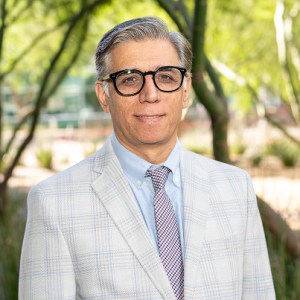
Bringing 16 years of experience in the fields of education and assessment, Dr. Ebrahim Talaee is an Associate Professor and Assistant Dean, Curricular Assessment and Evaluation at the University of Arizona College of Medicine, Phoenix. He holds a Bachelor’s degree in Teaching English as a Second/Foreign Language, a Master of Science (MSc) in Educational Research Methodology, and a Doctor of Philosophy (DPhil) in Curriculum, Assessment and Instruction from the Department of Education at the University of Oxford.
Dr. Talaee began his career in the educational field as a schoolteacher before moving into research, instruction, and leadership roles in higher education across multiple jurisdictions. Recently, after serving as the founding Lead for Assessment at the newly established School of Medicine at Toronto Metropolitan University, Dr Talaee relocated to Phoenix Arizona, where he assumed his current position.
Throughout his career, he has been awarded several prestigious competitive scholarships and leadership opportunities, including the British Council’s Chevening Scholarship and the Fulbright Hubert H. Humphrey Fellowship, which enabled him to pursue research and advanced study at the University of Oxford and Pennsylvania State University, respectively.
Dr. Talaee has extensive expertise in analyzing large-scale assessment and instructional data, developed through his involvement in major longitudinal studies such as the Effective Pre-school, Primary and Secondary Education (EPPSE) project in the United Kingdom and the National Educational Panel Study (NEPS) in Germany.
In the field of professional education, Ebrahim explains that his research on teacher education led him to develop theoretical frameworks that have informed professional education across other disciplines. Over the past decade, he has made tremendous contributions through his research and publications on pre-service and in-service training, professional identity formation, the assessment of “hard-to-assess” areas of development, curriculum design and analysis, training program evaluation and the link between the theoretical and practical realms of professional education.
Ebrahim is passionate about developing assessments that are an integral part of education rather than an added component. He describes education using the metaphor of a tripod, with curriculum objectives typically forming the longest leg, instruction the second, and assessment being the shortest, resulting in an unbalanced and unaligned system. His current work focuses on “testless assessment” and precision medical education, where students generate data through their learning process using technology. This data provides meaningful insights for teachers to inform instruction while supporting learners for self-regulation.
Ebrahim describes his project, “AI in the Learning Mode,” which focuses on using AI to develop foundational skills in education rather than providing direct answers. He emphasizes that AI should support the development of critical thinking, problem-solving, and reflective skills in learners, rather than contributing to what he describes as a “never-skilling” generation that relies on AI for answers without acquiring these essential capabilities. According to Ebrahim, many current AI applications emphasize an “answer mode” approach, missing valuable opportunities to enhance learning.
Ebrahim first became involved with Vretta through the International Association for Educational Assessment (IAEA) conferences, which he has attended over the past decade. There he met members of the Vretta team and was subsequently invited to serve as an assessment consultant on an early mathematics assessment project in collaboration with professors from Carleton University. In that role, he worked as an assessment data scientist, focusing on the development of student screening tools. He continues to contribute to ongoing projects related to early mathematics and reading screening.
Today, Ebrahim primarily consults on assessment tool design and validation and workplace-based medical education assessments. His work also includes research on Objective Structured Clinical Examinations (OSCEs) and authentic workplace assessments.
Ebrahim takes pride in his career in education, particularly in preparing future workforces through K-12, teacher, and medical education. He has extensive experience designing Research and Development (R&D) studies in which research findings are applied to develop a product in assessment and instruction. Most of the products he has developed collaboratively with teams of psychometricians, data analysts, and software developers are designed to make assessment and evaluation practices more efficient, effective, and engaging.
Currently, he is leading the design and development of two programs: a program evaluation product and a programmatic assessment tool. The former is intended for a higher education institution which requires near real-time data on key indicators of process and outcome quality. The latter is designed for students and their coaches to track, monitor, and support a successful learning path with the ability to predict performance at key milestones based on historical large-scale assessment data.
Ebrahim currently serves as Conference Ambassador for the Middle East and US in Medical Education and Assessment for the 51st Annual International Association for Educational Assessment (IAEA) Conference, to be held in Toronto from September 27 to October 2, 2026. The conference is hosted by the Education Quality and Accountability Office (EQAO) in collaboration with its technology partner, Vretta. You can learn more about the conference on the conference website: https://www.eqao.com/iaea-annual-conference/.
Away from his professional responsibilities, Ebrahim enjoys spending time with his family, biking, and hiking in Arizona when the weather permits. Feel free to reach out to him at: ebrahimtalaee@arizona.edu.

