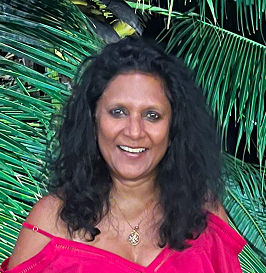
Amina Afif describes herself as having a ”multi-profile.” Over a career spanning Luxembourg, the Seychelles, France, and international institutions from the OECD to the IEA to AEA-Europe, she has moved fluidly between roles as statistician, data division head, school improvement adviser, digital project coordinator, life coach, and international network builder. Yet for all that variety, a single thread has run through her work from the very beginning: “Assessment only matters if it improves learning,” she says simply. “Assessment without deeper meaning is pointless.”
Her educational background includes a Master of Arts (MA) in Statistics from the University of Southampton, and a Master’s degree in Educational Statistics and Research Methods from The Open University (UK).
After completing her MA, Amina joined Luxembourg’s education system, where she was responsible for analysing school data to generate insights that could support schools. Over the next fifteen years, she rose to become Head of the Data Division at SCRIPT — Luxembourg’s national curriculum and educational research service — a role she held for a decade. In her words, it was a position that “connected policy, data, evaluation, and school improvement at the system level.” The work consistently focused on closing the loop between data and practice. “It was all about the school development plan,” she explains. “How do you use data? How do you train people to use that evidence to actually change things in a school?” During this time, she also represented Luxembourg internationally at the OECD, the IEA, and AEA-Europe, while working closely with school management and data teams across the country.
One of the projects she is most proud of from that period is MathemaTIC — a digital adaptive learning and assessment platform built in partnership with Vretta, the Canadian educational technology company. The problem Amina and her colleagues set out to address was rooted in Luxembourg’s remarkable linguistic complexity. With approximately 70% of students coming from non-Luxembourgish-speaking backgrounds — speaking Portuguese, French, German, English, and other languages at home — many genuinely capable students were underperforming in mathematics simply because instruction was delivered in German, a language they did not fully understand.
Amina initiated the collaboration with Vretta and coordinated the broader project — bringing together teachers and researchers from France and Luxembourg, engaging university research partners, and overseeing implementation in schools. While Vretta built the platform, Amina led the collaboration around it. The result was a highly effective multilingual adaptive mathematics platform available in German, French, English, and Portuguese.
Another initiative that Amina takes great pride in is FLIP+ (an acronym derived from France, Luxembourg, Italy, and Portugal), which originated out of a conversation around a coffee table in 2017. Amina, along with colleagues Roberto Ricci (Italy), Helder Sousa (Portugal), and Thierry Rocher (France), conceptualized a collaborative association to develop and share digital assessment resources. Today, FLIP+ is an international collaboration platform for shared digital assessment development, bringing together 22 institutional members across Europe and beyond — including partners from France, Italy, Portugal, Norway, Lithuania, the Netherlands, Brazil, Canada, and Morocco. Its centrepiece is the FLIP+ Library: an international digital item library where the ambition is for public educational institutions to contribute pre-tested, psychometrically validated assessment content that can be translated and shared across countries.
Amina serves as Executive Secretary of FLIP+, Project Executive of the FLIP+ Library, and coordinator of the six Working Groups — covering content development, artificial intelligence, accessibility and inclusion, psychometrics, technology, and strategic planning.
Amina summarizes her career with characteristic clarity: “I am proud of helping schools use data for improvement in ways that support learning rather than simply measure performance. I am also proud of representing small states and diverse voices internationally. And I am proud of trying to bridge technical assessment work with human purpose.” The thread connecting these reflections is consistent: assessment is not an end in itself. It is a tool in the service of something larger. And the people and systems surrounding that tool matter as much as the tool itself.
When asked about online assessment, Amina acknowledges the strong potential of digital assessment, but only if validity, fairness, accessibility, and meaningful use are safeguarded. She states that, “digital assessment can offer richer tasks, more efficient delivery, and better feedback loops — but technology alone does not improve learning.”
Her view on AI in assessment is nuanced and worth quoting at length: “I am convinced that AI can do things that would save us time, so as to leave us more space for human interaction with learners. When AI is used with sound design, with trust, with the capacity of educators and leaders to use assessment data meaningfully – or provide feedback in real time – which teachers struggle to do for a whole class, then AI offers us much value added. But AI alone cannot replace the validity, fairness, or accessibility of assessments. It has to be used smartly and support educators to enhance teaching and learning.”
She is equally alert to the risks of misinformation, cognitive passivity, and the potential for systems to be “dumbed down” if students and teachers become over-reliant on AI-generated outputs. “If we are not mindful and careful, we can get carried away and not be as cognitively engaged anymore because we stop activating that part of our brain.” Her response to teachers who fear being replaced by AI is direct: “You will be replaced by AI if you do not know how to use AI.” Yet she is equally clear about what AI cannot replicate. “A robot can duplicate speed; it can duplicate content. But it will never duplicate trust and the real interaction of teaching.”
Away from professional commitments, Amina describes herself as “a very family-oriented person.” She comes from a family of six in the Seychelles, has two sons, and finds deep fulfilment in time spent with loved ones. She enjoys island music, dancing, cooking, reading, fitness, and the kind of easy, warm sociability that carries over naturally into her professional relationships. She is also, quietly, a student of personal growth and well-being — a dimension that shapes her human-centred leadership as much as any formal training.
She practices mindfulness and gratitude daily. “I don’t have a to-do list,” she says. “I have a to-be list. Who am I? How am I being every day, in everything I do, and with everyone I meet?”
Please feel free to reach out to Amina at: amina@aminaafif.com.
 RMJ ASSESSMENT