Introduction
This article is a companion piece to my recent account, which describes English-language provincial assessments in Quebec.[1] As reported in my previous article, Quebec’s education and large scale student assessment systems/programs, although similar to other Canadian provinces in many respects, are unique in important ways. For instance, following pre-primary education (kindergarten), the education systems in most of Canada are divided into three stages: Grades 1 to 8 (primary/elementary), Grades 9 to 12 (secondary) and post-secondary (college and university). In Quebec, primary/elementary education spans Grades 1 to 6, secondary includes Grades 7 to 11, and CEGEP (Collège d’enseignement général et professionnel), the equivalent of Grade 12, from which students receive a diplôme d’études collégiales (DEC) upon completion of a technical or pre-university program[2] (Quebec students typically attend CEGEP instead of Grade 12, as the college education is designed to bridge the gap between completing secondary school in Grade 11 and attending university.[3]) Quebec has publicly funded French- and English-language schools. In publicly funded primary and secondary schools, all students must attend a French-language school, except in cases of students being eligible for instruction in English in accordance with the Charter of the French Language[4].
The province has a long-standing history of administering standardized provincial student assessments.[5] Curriculum-based assessments, conducted by the Ministry of Education, are administered in given subjects at key stages in students’ educational learning path and serve as important gauges of their competency development. This article provides a high-level overview of the current status of Quebec’s French language, large-scale student assessments, commonly referred to as ministerial examinations. Also included are descriptions of the French as a second language exams (core and enriched programs) that are administered to students whose first language is English.
French Ministerial Examinations
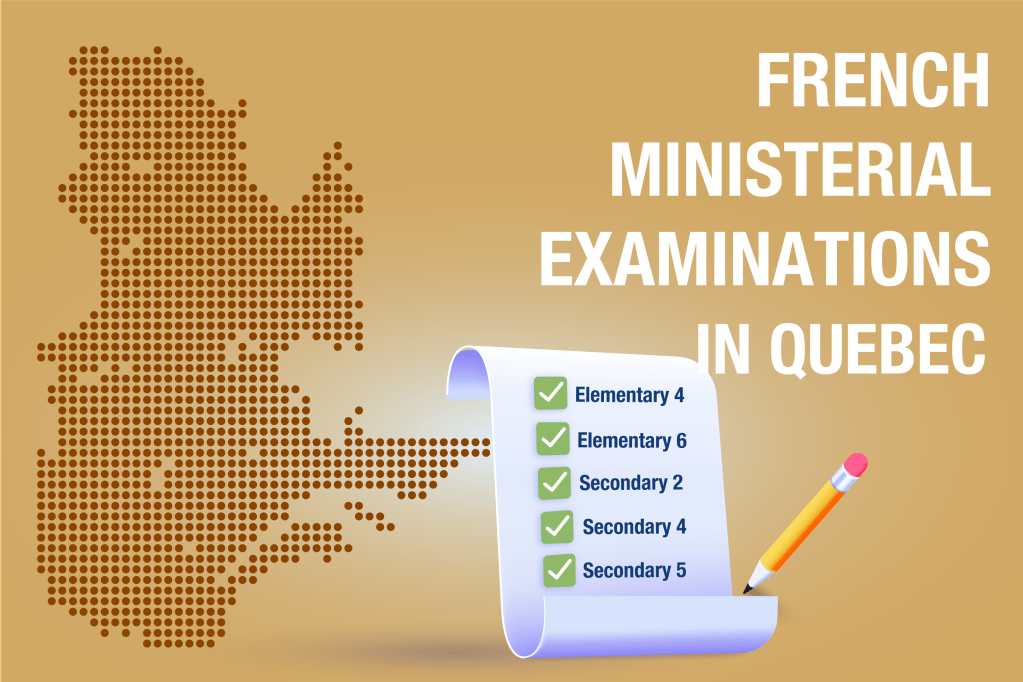
The Ministry of Education develops and administers two types of ministerial examinations: those for students in elementary school and Secondary 2 and those for Secondary 4 and 5. In Grade 4 (Elementary 4), French-first-language students write a Français, langue d’enseignement test; students in Grade 6 (Elementary 6) sit for a Français, langue d’enseignement, as well as a mathematics examination. (There are two Français, langue d’enseignement tests for each grade [4th and 6th], namely a reading test and a writing test, but there is only one mathematics exam in Grade 6.). Grade 8 (Secondary 2) French students take a Français, langue d’enseignement test. The Elementary and Secondary 2 ministerial examinations, designed to verify that the requirements for the related curricular programs have been met, count for 20% of the student’s final result for the competency or competencies evaluated. The Grade 10 (Secondary 4) exams test students’ competencies, based on the related curriculum expectations, in mathematics, science and technology or applied science and technology (students are enrolled in one of the science courses, not both) and history of Quebec and Canada. Grade 11 (Secondary 5) exams test students on their knowledge and skills in Français, langue d’enseignement and English as a second language (core and enriched programs). Second language learning — English as a second language (for French first language students) and French as a second language (for English first language students) — is a fundamental component of education in Quebec, including its assessment program. All students in Grades 10 and 11 are required to take their respective tests, which count for 50% of the final result for the competency or competencies evaluated and not for the course.[6]
Ministerial examinations for Elementary 4 and Secondary 2 are administered annually in June; exams for Elementary 6 are taken in January (for Elementary 6 students who have completed the prescribed curriculum content and are about to begin intensive English instruction) and June; and all Secondary 4 and 5 tests are administered in June, with retake opportunities offered in August and January. In the following sections, high-level descriptive information is provided for the ministerial examinations administered to students whose first language is French.
Elementary 4 Examination
Français, langue d’enseignement[7]
To demonstrate their reading skills, students are expected to read a variety of texts and then complete writing tasks. Students’ reading performance is assessed through their reading, critically analyzing and synthesizing ideas that form the basis for their written responses. The reading test is administered over two days (90 minutes each day). The first half-day is devoted to literary text and the second to informational texts. During each of the sessions, students read the text and answer approximately a dozen questions, responses to which may include numbers, a few words or a few sentences. The writing test is administered over three days. Students demonstrate their writing ability by planning and writing text based on an illustration provided by the Ministry. On Day One (90 minutes), a presentation of the task and preparation and planning of the writing project takes place. On Day Two (90 minutes), students draft and make preliminary revisions to their text. On the 3rd day (two hours), students review, edit/correct, and finalize their writing products. Examples of test questions/tasks can be accessed here.[8]
For virtually all ministerial examinations, school boards and independent schools are responsible for marking students’ written responses. The Ministry provides marking guides, including scoring rubrics and exemplars, which describe performance levels. The reading tasks are scored with reference to criteria presented in the table below.
| Evaluation Criteria | Description |
|---|---|
| Understanding the significant elements of a text | Extraction of explicit information elements The student notes one or more pieces of information mentioned in the text. Extraction of implicit information elements The student finds a meaning that is not stated explicitly but is implied in the author’s words. The inferred meaning is common to the majority of readers. |
| Relevant justification of reactions to a text | The student justifies their reaction by relying on elements from the text. |
| Critical judgement on literary texts | The student appreciates certain characteristics of a work. |
Five criteria, used for the evaluation of students’ writing performance (each counting for 20% of the overall score), are as follows:
- Adaptation to the writing situation
- Text consistency
- Use of appropriate vocabulary
- Sentence construction and appropriate punctuation
- Compliance with standards related to the appropriate use of spelling and grammar
Students’ scores for each of the criteria are described by five performance categories:
- A (Very Satisfactory — 20 points)
- B (Satisfactory — 16 points)
- C (Acceptable — 12 points)
- D (Low Satisfactory — 8 points)
- E (Unsatisfactory — 4 points).
To derive the student’s reading result, the teacher adds up the points obtained for the responses to the two parts/tasks of the test and transforms the score to a total out of 100. For writing, the teacher adds up the scores recorded for each criterion to determine the final total out of 100.
Elementary 6 Examinations
Français, langue d’enseignement[9]
The Français, langue d’enseignement reading test comprises two tasks, which are administered over two half-days. Approximately two and a half hours is allocated for each task. The first session is devoted to a literary text and the second to a narrative text. Both sessions begin with the presentation of the text, followed by reading the text and responding to a series of related questions. With reference to the associated content, the student is expected to answer approximately 12 questions. Responses may take the form of numbers, a few words or a few sentences. The writing test is also spread over two half-days. The student’s task is to write a letter addressed to a given recipient to present their opinion in relation to the topic of the informational text. Day One involves planning and then completing a first draft of the text; on Day Two, the student edits, revises, proofreads and finalizes the writing product. Sample reading and writing questions/tasks can be accessed here.[10]
As previously mentioned, school boards and independent schools are responsible for marking students’ written responses to ministerial exams, and to support the marking process, the Ministry provides educators with scoring guides, including rubrics and exemplars, which describe performance levels. The reading tasks are scored using a Ministry-developed marking key, which is based on criteria presented in the table below.
| Evaluation Criteria | Description |
|---|---|
| Understanding the significant elements of a text | Extraction of explicit information elements The student notes one or more pieces of information mentioned in the text. Extraction of implicit information elements The student finds a meaning that is not stated explicitly but is implied in the author’s words. The inferred meaning is common to the majority of readers. |
| Plausible interpretation of a text | The student suggests a meaning that is not in the text, not even implicitly. They create meaning by drawing inspiration from the text and remaining faithful to it. The interpretation of the text may vary from one reader to another. |
| Relevant justification of reactions to a text | The student justifies their reaction by relying on elements from the text. |
| Critical judgement on literary texts | The student appreciates the work as a whole, using relevant examples. |
Scoring of the student’s writing product is conducted using the same criteria and rubric that is referenced for the Elementary 4 Français, langue d’enseignement examination.
Mathematics[11]
The ministerial mathematics examination is administered to evaluate students’ competencies, using various tasks, to:
- Solve situational mathematics problems.
- Reason using mathematical concepts and processes.
The Ministry provides students with the following documents for the January and June exams.
To assess the competency: To solve a situational mathematics problem:
- A Reference Document
- A Student Booklet
To assess the competency: To reason using mathematical concepts and processes:
- A Question Booklet
- three booklets (one for each of the three application situations)
The tests take place over three days. Day One involves addressing two application situations; Day Two involves students responding to a situational problem; and Day Three involves students completing the third application situation and questions in a Question Booklet. The three application situations and the questions in the Question Booklet allow the skill of reasoning using mathematical concepts and processes to be assessed. To derive the result out of 100, a weighting of 60% is given to all three situations combined, with a weighting of 40% given to the Question Booklet. The situational problem allows the skill of solving a situational mathematics problem to be assessed. The result of the situational problem is expressed out of 100%.
On Day One: Students receive a booklet for the first application situation. In the preparation phase, the assessor reads the task with the students before they begin their work. (The assessor may clarify or explain any non-mathematical terms, if necessary, and the time allocated to this stage may vary depending on the students’ needs.) In the implementation phase, the students have 30 minutes to complete the task, including recording all of their work (reasoning) and the results/answers in their booklets. The assessor may allow up to 15 minutes of extra time, if needed, to allow a student to complete the task. The student then receives the booklet for the second application situation, and the task is carried out in the same way as the first task. The application situations present varied contexts, which allow the student to:
- Choose and apply the required mathematical concepts and processes, and present an approach that makes its reasoning explicit.
- Justify a statement, to verify a result or an approach, to take a position, criticize or convince using mathematical arguments.
On Day Two: Students receive a copy of the Reference Document, which presents the situational problem, as well as a copy of the Student Booklet, in which they record all of their work and the resulting answer. In the preparation phase, the assessor reads the task with the students before they begin their work. Once again, the assessor may explain any non-mathematical terms, if necessary, and the time required for this phase may vary. In the completion phase, the student has two hours to complete the task, with approximately 30 minutes of extra time allotted should they be needed by the student to complete the work. The situational problem meets all of the following conditions:
- The situation involves the student’s choice of mathematical concepts and processes required.
- The approach to reaching the solution is not immediately obvious, since it requires the students to determine for themselves how to combine the mathematical concepts and processes required to solve the problem.
- The situation calls for various strategies of understanding, organization, solution, validation and communication.
- The instructions do not provide any information on the procedure to follow or on the strategies, concepts or processes to be used.
On Day Three: Students receive the Workbook for the third application situation and complete the task according to the procedures described for the first two application situations. Next, the students receive a Question Booklet with two sections. In the preparation phase for each of the two sections, the assessor reads the instructions and may clarify or explain any non-mathematical terms, if necessary. Section A of the Question Booklet includes a question presenting four mental arithmetic operations to be performed. Each question is worth one point, for a total of four points. One after the other, the questions are displayed on a visual aid. The first question is read by the assessor twice, the students have ten seconds to perform the mental arithmetic, then they write the result of the calculation in their Notebooks. The same procedure is followed for the other three operations. This part of the test lasts approximately five minutes. In Section B, the students answer 18 selected-response or short-answer questions in writing in their booklets. Each question is worth two points, for a total of 36 points. Students have 60 minutes to complete the Question Booklet; the assessor may allow up to 15 minutes of extra time for a student to complete the work. The questions in the Booklet are meant to assess students’ acquisition of knowledge and understanding of mathematical concepts and processes.
Examples of mathematics examination materials (example questions and rubrics) can be accessed here.[12]
Secondary 2 Examination
Français, langue d’enseignement[13]
The ministerial test in Français, langue d’enseignement in the second year of secondary school, assesses students’ writing ability. Students are expected to write a single text that must include both descriptions and justifications. The writing task takes place at two separate times. First, there is a preparation session of three hours and twenty minutes. Approximately two weeks before completing the writing task, the student receives a preparatory file, which includes the writing task, activities to explore the topic, all the texts to be read, as well as a notebook. During this session, the student reads information about the test, completes preparatory activities and reads the supplied texts. The student may also consult the evaluation rubric used in marking the final, written product. During this period, the student identifies information they consider relevant to the writing task and records and organizes the information in their notebook. (The activities in the preparatory session are mandatory, but they are not assessed.) At the conclusion of test preparation, students must give the assessor all of the documents provided to them. Before the day of the writing task, an evaluator checks to ensure the students’ notebooks do not contain any text that is written in advance.
During a separate three-hour session, students write a text of approximately 300 words, in which they present elements of description and justification in response to the writing task. In their writing, students are expected to:
- use appropriate descriptive and justificatory elements to complete their task;
- organize their text appropriately;
- ensure textual coherence (relevance, non contradiction, continuity, progression);
- use their linguistic knowledge, including that acquired in the first cycle of secondary school; and
- employ revision and correction (editing) strategies to improve and correct the text.
During the writing session, students are permitted to use the following resources:
- Their test notebook
- Any standard or specialized unilingual French dictionary
- Grammatical guide
- Conjugation table
- Reference material owned by the student or made available by the school
Marking of the texts is conducted locally with reference to the following documents:
- An evaluation rubric, which describes the observable elements associated with five criteria
- A corresponding table, which indicates the weighting of the criteria
- Benchmarks for assigning ratings, which indicate the number of points to be awarded based on the number of errors in spelling, punctuation and grammar
Examples of materials contained in a test preparatory file, as well as scoring-related documents, are presented in the Guide for Parents. (Refer to footnote #13.)
Secondary 4 Examinations
Mathematics[14]
Midway through Grade 9 (Secondary 3), students choose which of three options (math levels) they will take in Secondary 4. The following table provides information about the percentage distribution of marks for each of three math options and for each branch of mathematics. The math options are: Cultural, Social and Technical (Basic math), Technical and Scientific (hands-on math) and Science (relatively high-level math).
| Mathematics Option | Algebra | Statistics & Probability | Geometry |
|---|---|---|---|
| Cultural, Social & Technical | 28 to 36% | 12 to 20% | 46 to 54% |
| Technical & Scientific | 36 to 48% | 16 to 28% | 32 to 44% |
| Science | 48 to 54% | 4 to 10% | 38 to 44% |
The mathematics examination is divided into three parts. The following table provides a breakdown, for each part: the item/task type, number of items/tasks, number of marks per item/task and the total number of marks available.
| Examination Part | Item/Task Type | Number of Items/Tasks | Number of Marks Per Item/Task | Number of Marks |
|---|---|---|---|---|
| Part A | Multiple-Choice | 6 | 4 | 24 |
| Part B | Short-Answer | 4 | 4 | 16 |
| Part C | Situations Involving Applications | 6 | 10 | 60 |
Total Marks: 100
According to the associated Information Document, the questions in Parts A and B of the examinations are intended to evaluate mastery of mathematical concepts and processes, and Part C requires students to explain their mathematical reasoning and organize and apply mathematical concepts and processes in a clearly defined context.
Three hours are allotted to the math examination with 15 minutes of extra time if needed. Examples of mathematics examination materials can be accessed in the Guide for Parents. (Refer to footnote #14.)
In terms of marking responsibilities, whenever scannable answer sheets are used to record students’ responses, some questions are marked by the Ministry. (More specifically, the answers to the multiple-choice questions in Section A, recorded on the scannable answer sheets, are marked by the Ministry, whereas the results for Sections B and C are recorded in pencil by teachers. Scannable sheets are only used for the June session.) Otherwise, school boards and schools are responsible for marking students’ work in accordance with Ministry instructions and marking guides. A five-performance- level rubric is used to mark the situations involving applications in Part C of the exams. The Ministry then enters the results from all three sections to determine the student’s final exam mark.
Science and Technology or Applied Science and Technology[15]
According to the Ministry of Education, the examinations in Science and Technology and Applied Science and Technology require students to analyze situations and a technical object (students are enrolled in one of the science courses, not both).[16] Working alone, students must solve various problems using their knowledge of the compulsory concepts in three of the four major areas of the program. The Science and Technology exam comprises 25 questions worth four marks each and is divided into three parts:
- Part A: 15 multiple-choice questions, evaluating students’ proficiency in or ability to use knowledge related to the compulsory concepts (worth 60% of the student’s mark)
- Part B: Five constructed-response questions (worth 20% of the student’s mark)
- Part C: Five questions on the technological analysis of a technical object (worth 20% of the student’s mark)
The following table shows the distribution of questions in each of the major content areas in the Science and Technology Program, as well as the related weighting.
| Exam Part | Number of Questions | The Living World | The Earth and Space | The Material World | The Technological World | Weighting |
|---|---|---|---|---|---|---|
| A | 15 | —– | 4 | 10 | 1 | 60% |
| B | 5 | —– | 1 | 3 | 1 | 20% |
| C | 5 | —– | —– | —– | 5 | 20% |
| Totals | 25 | —– | 5 (20%) | 13 (52%) | 7 (28%) | 100% |
Like Science and Technology, the Applied Science and Technology exam consists of 25 questions worth four marks each. The test is divided into three parts:
- Part A: 15 multiple-choice questions, evaluating students’ proficiency in or ability to use knowledge related to the compulsory concepts (worth 60% of the student’s mark)
- Part B: Four constructed-response questions (worth 16% of the student’s mark)
- Part C: Six questions on the technological analysis of a technical object (worth 24% of the student’s mark)
The following table shows the distribution of questions in each of the major content areas in the Applied Science and Technology Program, as well as the associated weighting.
| Exam Part | Number of Questions | The Living World | The Earth and Space | The Material World | The Technological World | Weighting |
|---|---|---|---|---|---|---|
| A | 15 | —– | 1 | 9 | 5 | 60% |
| B | 4 | —– | 1 | 2 | 1 | 16% |
| C | 6 | —– | —– | —– | 6 | 24% |
| Totals | 25 | —– | 2 (8%) | 11 (44%) | 12 (48%) | 100% |
Since each of the three parts of the Science and Technology and Applied Science and Technology examinations is designed to be stand-alone, students can begin responding to any question(s) in any part of the examination they choose, as long as they do so independently. In analyzing a technical object, students view a video (which plays continuously during the examination) and examine diagrams to understand how it works. The time allotment for the examinations is three hours, with 15 minutes of extra time if needed. Examples of Science and Technology and Applied Science and Technology examination materials can be accessed via the Guide for Parents. (Refer to footnote #15.) With respect to marking, when scannable answer sheets are used (June session only) to record students’ responses, some questions are marked by the Ministry. (More specifically, the answers to the multiple-choice questions in Section A, recorded by the students on the scannable answer sheets, are marked by the Ministry, whereas the results for Sections B and C are recorded in pencil by teachers.) Otherwise, school boards and schools are responsible for marking students’ work in accordance with Ministry instructions and marking guides. Just like the other examinations, the Ministry recommends that teachers form local marking committees to ensure they have a common understanding of the instructions and performance standards. For both examinations, the Ministry enters the results from all three sections to determine the student’s final exam mark.
History of Québec and Canada[17]
The Secondary 4 ministerial examination on the History of Québec and Canada is a 23-question exam, which is based on the program content pertaining to four time periods and social phenomena as follows:
| Period | Social Phenomenon |
|---|---|
| 1840-1896 | Formation of the Canadian Federal System |
| 1896-1945 | Nationalisms and the Autonomy of Canada |
| 1945-1980 | Modernization of Quebec and the Quiet Revolution |
| 1980-present | Societal Choices in Contemporary Quebec |
Students are required to analyze and interpret a variety of documents (e.g., written or illustrated historical documents, writings by historians, diagrams, tables, illustrations, maps, timelines), as well as draw on their personal knowledge, to respond to the exam questions. The test is designed to evaluate the learning associated with evaluation criteria identified in the descriptions of the following three examination parts:
- Part A comprises 21 multiple-choice and/or short-answer questions, which are associated with the evaluation criterion: Appropriate use of knowledge.
- Part B consists of one question, related to the evaluation criterion: Coherent representation of a period in the history of Québec and Canada (which involves completing a diagram).
- Part C contains a single question that relates to the evaluation criterion: Rigour of the interpretation and requires the preparation of a written response of approximately 150 words.
The following table presents the distribution of questions for each part of the exam, time period and associated social phenomenon.
| Time Period/ Social Phenomenon Part | 1840-1896 Formation of the Canadian Federal System | 1896-1945 Nationalisms and the Autonomy of Canada | 1945-1980 Modernization of Quebec and the Quiet Revolution | 1980-Present Societal Choices in Contemporary Quebec | Total |
|---|---|---|---|---|---|
| Part A | 5/6 questions (9 to 14 marks) | 5/6 questions (9 to 14 marks) | 5/6 questions (9 to 14 marks) | 4/5 questions (7 to 12 marks) | 21 questions (44 marks) |
| Part B | 1 question on one of the periods (8 marks) | 1 question (8 marks) | |||
| Part C | 1 question on one of the social phenomena (8 marks) | 1 question (8 marks) | |||
23 question
(60 marks)
The examination takes three hours to complete, with 15 minutes of extra time available if needed. Sample questions can be accessed via the Guide for Parents. (Refer to footnote #17.) Responsibility for marking resides with the educational institutions. Marking guides containing answer keys, scoring rubrics and an explanation of marking procedures are provided by the Ministry. As indicated in the table above, the result of the examination is out of 60 marks.
Secondary 5 Examinations
Français, langue d’enseignement[18]
The Français, langue d’enseignement test in the 5th year of secondary school assesses students’ ability to write a single text that must include both justifications and arguments. (The assessment is similar in many ways to the Secondary 2 examination.) The test takes place in the examination room at two separate times. The first stage, spread over two periods (a total of approximately three hours and twenty minutes), involves preparation for the test. About one week prior to the writing task, the students receive a preparatory file, which includes various activities related to the subject of the test, five to eight common texts on the subject and a note sheet. Preparation involves various activities, such as reading the texts, participating in group discussions and taking notes. Students may also consult the evaluation rubric used to mark the final, written product. During preparation, students identify information relevant to the writing task and record and organize information in their note sheets. (Students are permitted to continue their preparations at any time outside of the examination room. Although mandatory, preparation activities are not assessed.)
In a separate three-hour session, students complete the writing task, which involves constructing an open letter of approximately 500 words, using their note sheet and any authorized references. (Up to 15 minutes of extra time is available to students if needed.) In the open letter, the student is expected to:
- state a position (thesis) and present ideas in depth with coherence (relevance, non contradiction, continuity, progression);
- use an argumentative process studied by the end of the second cycle of secondary school;
- support remarks with relevant information;
- use their linguistic knowledge acquired during schooling;
- transfer learning from reading and oral communication; and
- employ revision and correction (editing) strategies to improve and correct the text.
During the writing session, the following authorized resources are permitted:
- The student’s note sheet
- Any standard or specialized unilingual French dictionary
- Grammatical guide
- Conjugation table
- Reference material owned by the student or made available by the school.
The writing products are marked centrally at the Ministry of Education, using evaluation rubrics, which describe observable elements associated with five criteria:
- Adaptation to the communication situation
- Coherence of texts
- Using appropriate vocabulary
- Constructing sentences and using punctuation appropriately
- Using spelling and grammar appropriately
A separate table is provided that indicates, for criteria #4 and #5, the number of points to be awarded based on the number of errors in spelling, punctuation and grammar. The scoring rubrics can be viewed in the Information Document and Guide for Parents, and examples of writing test materials can be accessed via the Guide for Parents. (Refer to footnote #18.)
English as a Second Language (Core and Enriched Programs)[19]
Core Program
The English as a Second Language (Core Program) test assesses students’ oral and written skills; hence, there is an oral interaction and a written production component. Based on a given topic, students complete a preparatory task in which they participate in discussions with their peers, take an oral interaction test, and then write an opinion article.
Preparatory Task
Like the other language examinations, the preparatory activity is an integral part of the test but it is not assessed. In preparation, students, individually, read texts presented to them in a Preparation Booklet and respond to them in writing. In teams of four, students discuss the texts in English to gain a better understanding of the topic. The preparation stage is approximately 45 to 60 minutes in duration.
Oral Interaction Test
Based on a series of provided questions, students, in teams of four, are expected to engage in a sustained discussion in English for 15 minutes. The teacher observes and evaluates the discussion among students (without participating in it). Although the test is conducted in teams of four, the assessment is individual, meaning that the teacher assesses each student’s oral proficiency with reference to performance rubrics.
Written Product Test
Students, individually, write an opinion article in English for a web magazine. The article’s length is approximately 225 words and is in response to a question related to the topic presented in the Preparation Booklet. The written product component of the test is about two hours long.
Students are permitted to bring their own reference material or use those made available by the school. For the preparatory task and oral interaction test, students may have reference to the Preparation Booklet and paper dictionaries (English and bilingual). For the Written Product Test, students may use paper dictionaries (English and bilingual), a thesaurus and a grammatical guide. Examples of performance rubrics can be viewed in the related Information Document.
Enriched Program
The English as a Second Language (Enriched Program) test assesses students’ reading comprehension and writing skills. Much like the Core Program, the Enriched Program’s test has preparation and assessment sessions. The preparatory stage (about 60 minutes) involves students reading texts, listening to an audio recording and participating in a group discussion to consolidate their ideas on the given topic. These activities help students acquire knowledge and vocabulary associated with the topic. On the day of the test, the students listen to the audio recording again and then write, in English, an informative background article (approximately 400 words) on the issue or trend provided. The teacher, with reference to Ministry scoring rubrics, provides two separate reading comprehension and writing results for each student. Rubrics can be accessed in the related Information Document.
French as a Second Language (Core and Enriched Programs)[20]
French as a second language (for English first language students) is a fundamental component of education in Quebec and an important component of the ministerial examinations.
Core Program
The Core Program tests focus on the skills of written comprehension, interacting orally and producing written products in French.
Written Comprehension Examination
The written comprehension test begins with an introductory task to help students prepare to read the texts in the examination. In teams of three to f ive, students participate in a 30-minute discussion in French, during which time they discuss the topics, questions or statements presented in the reading preparation notebook, which is provided. (The task is mandatory, but is not evaluated.) Following this activity, and working independently, the students have two hours and 30 minutes to read a collection of texts provided and then answer reading comprehension questions. There are three types of questions: selected-response, short-answer and one extended constructed-response question. For the June exam, students answer the selected-response questions on a scannable answer sheet that can be machine-scored by the Ministry. For the short- and longer-answer questions, candidates write their answers on the back of the scannable answer sheet. These responses are marked by the teachers, and the marks are compiled by the Ministry. For the August and January examinations, students record their answers in an answer booklet. Markers score the exam using instructions/guidelines provided by the Ministry.
Oral Interaction Examination
Before the oral test, the students take part in a mandatory preparatory task, in which they (at school or home) reread the collection of texts, and working in teams, they can share ideas about any aspects of the theme that might emerge during the oral interaction examination. (Once again, this preparatory task is not evaluated.) During the actual examination, the students, in teams of three to five, participate in a 12- to 15-minute discussion, in French, on a topic taken from the collection of texts. The discussion must take place only among the students in the team. The examiner evaluates each candidate’s French oral interaction in real time, using a rubric provided by the Ministry.
Written Production Examination
Working independently, students have two hours to write a French text of approximately 225 words on a topic related to the theme of the reading (written comprehension) examination. After two hours, the candidate may be allotted an additional 10 minutes if needed. The marker evaluates the text using Ministry-provided rubrics.
For all three components of the French as a second language (Core Program) exam, students are permitted to refer to a bilingual dictionary or a unilingual French dictionary. In addition, for the written production component, students can use a thesaurus, a grammar book and a book of verbs.
Excerpts/example questions for the French as a second language (Core Program) are available via the related Guide for Parents. Rubrics are included in the Guide for Parents and the Information Document.
Enriched Program
The French as a second language (Enriched Program) tests evaluate students’ written comprehension and writing skills. For both examinations, students are permitted to use the same materials/resources as were the case for the Core Program tests.
Written Comprehension Examination
The written comprehension exam has two parts, which occur consecutively in a single time slot. Students first participate in a preparatory task in teams, then continue the exam independently. To get ready for the test, students receive a copy of a preparation notebook to read, which presents questions or statements, as well as topics they will later read in the exam. In teams of three to five, students take part in a 30-minute discussion, in French, during which time they discover the theme of the exam and the topics that will be addressed in the texts. After the preparatory task (which is not scored), students receive three documents: a collection of texts on the theme presented in the preparatory task, a question booklet and a scannable answer sheet or an answer booklet (depending on the exam session). During a two-hour and 30-minute time block, candidates read the texts on their own and answer all the questions in the question booklet. Like with the Core Program test, the exam consists of three question types: selected-response, short-answer and extended-answer questions. Again, like the Core Program test, for the June exam, students answer the selected-response questions on a scannable answer sheet that can be machine-scored by the Ministry. Short- and longer-answer questions are written on the back of the scannable answer sheet. These responses are marked by the teachers, with reference to instructions provided by the Ministry. For the August and January exam sessions, students enter their responses in the answer booklet. If, at the end of the examination period, a student needs more time to complete the test, 15 additional minutes may be allotted. The students’ marks are compiled by the Ministry.
Written Production Examinations
Working independently, students have three consecutive hours to write a text of approximately 400 words, in French, in response to a question/ topic related to the theme of the collection of texts of the written comprehension exam. Their text must persuade the reader to take action. Candidates begin by reading the task/question, which is presented in a written product notebook, where they may also use a provided graphic organizer to write an outline of their draft. After revising and editing their texts, students write their final versions in a designated notebook. Students who have not completed the task within the three hours may be allotted an additional 15 minutes. Marking of students’ writing products is conducted using Ministry-provided scoring rubrics. Excerpts/ example questions for the French as a second language (Enriched Program) are available via the related Guide for Parents. Rubrics are included in the Guide for Parents and the Information Document
Conclusion
Quebec has a long-established, province-wide program of standardized tests designed, developed and overseen by the Ministry of Education. Although similar to other Canadian jurisdictions in many respects, Quebec’s examination system is unique in important ways.
The Ministry of Education develops and administers two types of ministerial examinations: those for students in elementary school and Secondary 2 and those for Secondary 4 and 5. In Grade 4 (Elementary 4), French-first-language students write a Français, langue d’enseignement test; students in Grade 6 (Elementary 6) sit for a Français, langue d’enseignement exam, as well as mathematics, and Grade 8 (Secondary 2) French students take a Français, langue d’enseignement exam. The Elementary and Secondary 2 ministerial examinations count for 20% of the student’s final course grade. The Grade 10 (Secondary 4) exams test students’ competencies, based on the related curriculum expectations, in mathematics, science and technology or applied science and technology, and history of Quebec and Canada. Grade 11 (Secondary 5) exams test students on their knowledge and skills in Français, langue d’enseignement and English as a second language (core and enriched programs) for French-first language students. English-first-language students sit for French as a second language (core and enriched program) examinations. All students in Grades 10 and 11 are required to take their respective tests, which count for 50% of the final result for the competency or competencies evaluated and not for the course.
As mentioned previously, whenever scannable sheets are used, the multiple-choice questions are marked by the Ministry; the other types of questions are marked by the teachers, at local scoring sites, using Ministry-prepared instructions and rubrics. The awarded marks are recorded on the scannable answer sheets. The exception to this is the Secondary 5 Français, langue d’enseignement exam, which is scored centrally at the Ministry of Education. Results of the Elementary and Secondary 2 exams are not made public by schools and school districts, whereas Secondary 4 and 5 results are publicly reported by the Ministry.
Second language learning: English as a second language (for French-first-language students) and French as a second language (for English-first language students) is a fundamental component of education in Quebec, including its assessment program.
Quebec’s examination program remains paper based, unlike the majority of Canadian provinces and territories, which have transitioned/are transitioning to digital, online assessments. Recently, the Ministry of Education has been exploring opportunities to move toward a digital, large-scale student assessment solution and continues to consider next steps.
About the Author
Dr. Jones has extensive experience in the fields of large-scale educational assessment and program evaluation. He has worked in the assessment and evaluation field for more than 35 years. Prior to founding RMJ Assessment, he held senior leadership positions with the Education Quality and Accountability Office (EQAO) in Ontario, as well as the Saskatchewan and British Columbia Ministries of Education. In these roles, he was responsible for initiatives related to student, program and curriculum evaluation; education quality indicators; school and school board improvement planning; school accreditation; and provincial, national and international testing.
Dr. Jones began his career as an educator at the elementary, secondary and post-secondary levels. Subsequently, he was a researcher and senior manager for a multi-national corporation delivering consulting services in the Middle East.
Feel free to reach out to Richard “Rick” at richard.jones@rmjassessment.com (or on LinkedIn) to inquire
about best practices in large-scale assessment and program evaluation.
Acknowledgement
The author wishes to express his appreciation to members of the Direction de l’évaluation des apprentissages, Quebec, Ministry of Education, for providing most helpful information and guidance during the preparation of this article.
References
[1] Sections of this article have been excerpted or adapted from: Jones, R.M. (2025, March). Assessing English Student Learning in
Quebec. Retrieved May 14, 2025 from: https://rmjassessment.com/2025/03/19/assessing-english-student-learning-in-Quebec.
[2] Guéhéneuc, Y-G. (January 11, 2024). Québec Education System — Explanation and Comparison. Retrieved January 28, 2025 from:
https://blog.ptidej.net/quebec-education-system-explanation-and-comparison.
[3] Government of Québec. (2025). Québec Education System. Retrieved January 29, 2025 from:
https://www.quebec.ca/en/education/study-quebec/education-system.
[4] Government of Québec. (2024). Charter of the French Language. Retrieved January 31, 2025 from: https://www.legisquebec.gouv.qc.ca/en/document/cs/C-11?langCont=en#ga:l-gb:l_viii-h1.
[5] Standardized assessments, for the purposes of this article, refer to those taken by students at a given grade/age level, testing the same/equivalent curriculum content within a common timeframe, and administered under common conditions.
[6] Information in this section was obtained from the following sources: Quebec Ministry of Education. (2024). About the ministerial examinations in elementary and secondary school. Retrieved January 28,
2025 from: https://www.quebec.ca/en/education/preschool-elementary-and-secondary-schools/programs-training-evaluation/ministerial-examinations-evaluation-learning.
Quebec Ministry of Education. (2024). Schedule for Ministerial Examinations and Retake of Examinations at the Elementary and Secondary Levels. Retrieved January 31, 2025 from: https://www.quebec.ca/en/education/preschool-elementary-and-secondary-schools/programs-training-evaluation/ministerial-examinations-evaluation-learning#c275757.
Cowley, P., & MacPherson, P. (2022). Testing Canadian K-12 Students—Regional Variability, Room for Improvement Across Canada: Comparison of K-12 Provincial Assessment Programs. Retrieved January 28, 2025 from: https://www.fraserinstitute.org/sites/default/files/testing-canadian-k12-students-regional-variability.pdf.
[7] Information in this section was obtained from the following document:
Gouvernement du Québec, Ministère de l’Éducation. (2024). Document d’information, ÉPREUVES MINISTÉRIELLES, Français, langue d’enseignement, 4e année du primaire, Lecture Écriture, Juin 2025. Retrieved April 9, 2025 from: https://cdn-contenu.quebec.ca/cdn-contenu/education/evaluation-epreuves-ministerielles/documents-information/DI_FLE_4e_prim.pdf.
[8] Gouvernement du Québec, Ministère de l’Éducation. (2024). Guide à l’intention des parents, ÉPREUVES MINISTÉRIELLES, Français, langue d’enseignement, 4e année du primaire, Lecture Écriture, Décembre 2024. Retrieved April 14, 2025 from : https://cdn-contenu.quebec.ca/cdn-contenu/education/evaluation-epreuves-ministerielles/documents-information/DI_FLE_4e_prim.pdf
[9] Information in this section was obtained from the following document:
Gouvernement du Québec, Ministère de l’Éducation. (2024). Document d’information, ÉPREUVES MINISTÉRIELLES, Français, langue d’enseignement, 6e année du primaire, Lecture Écriture, Janvier & Juin 2025. Retrieved April 8, 2025 from: https://cdn-contenu.quebec.ca/cdn-contenu/education/evaluation-epreuves-ministerielles/guides-parents/Guide_parents_FLE_6e_Prim.pdf
[10] Gouvernement du Québec, Ministère de l’Éducation. (2024). Guide à l’intention des parents, ÉPREUVES MINISTÉRIELLES, Français, langue d’enseignement, 6e année du primaire, Lecture Écriture, Décembre 2024. Retrieved April 14, 2025 from: https://cdn-contenu.quebec.ca/cdn-contenu/education/evaluation-epreuves-ministerielles/guides-parents/Guide_parents_FLE_6e_Prim.pdf
[11] Gouvernement du Québec, Ministère de l’Éducation. (2024). Document d’information, ÉPREUVE MINISTÉRIELLE, Mathématique, 6e année du primaire, Janvier Juin 2025. Retrieved May 22, 2025 from: https://cdn-contenu.quebec.ca/cdn-contenu/education/evaluation-epreuves-ministerielles/documents-information/DI_Math_6e_primaire.pdf
[12] Gouvernement du Québec, Ministère de l’Éducation. (2024). Guide à l’intention des parents, ÉPREUVE MINISTÉRIELLE, Mathématique, 6e année du primaire, Décembre 2024. Retrieved May 22, 2025 from: https://cdn-contenu.quebec.ca/cdn-contenu/education/evaluation-epreuves-ministerielles/guides-parents/Guide-parents-math-6e-prim.pdf
[13] Information in this section was obtained from the following documents:
Gouvernement du Québec, Ministère de l’Éducation. (2024). Document d’information, ÉPREUVE MINISTÉRIELLE, Français, langue d’enseignement, 2e année du secondaire, Écriture, Juin 2025. Retrieved April 14, 2025 from: https://cdn-contenu.quebec.ca/cdn-contenu/education/evaluation-epreuves-ministerielles/documents-information/DI_FLE_2e_sec.pdf
Gouvernement du Québec, Ministère de l’Éducation. (2024). Guide à l’intention des parents, ÉPREUVE MINISTÉRIELLE, Français, langue d’enseignement, 2e année du secondaire, Écriture, Décembre 2024. Retrieved April 14, 2025 from: https://cdn-contenu.quebec.ca/cdn-contenu/education/evaluation-epreuves-ministerielles/guides-parents/Guide_parents_FLE_2e_Sec.pdf
[14] Information in this section was obtained from the following documents:
Gouvernement du Québec, Ministère de l’Éducation. (2024). Document d’information, ÉPREUVES MINISTÉRIELLES, Mathématique, 4e année du secondaire, Culture, société et technique, Technico-sciences, Sciences naturelles, Janvier Juin Août, 2025. Retrieved May 24, 2025 from: https://cdn-contenu.quebec.ca/cdn-contenu/education/evaluation-epreuves-ministerielles/documents-information/DI_Math_4e_sec.pdf.
Gouvernement du Québec, Ministère de l’Éducation. (2024). Guide à l’intention des parents, ÉPREUVES MINISTÉRIELLES, Mathématique, 4e année du secondaire, Culture, société et technique, Technico-sciences, Sciences naturelles, Décembre, 2024. Retrieved May 24, 2025 from: https://cdn-contenu.quebec.ca/cdn-contenu/education/evaluation-epreuves-ministerielles/guides-parents/Guide_parents_Math_4e_Sec.pdf.
[15] Information in this section was obtained from the following sources:
Gouvernement du Québec, Ministère de l’Éducation. (2024). Document d’information, ÉPREUVES MINISTÉRIELLES, 4e année du secondaire, Science et technologie, Applications technologiques et scientifiques, Janvier Juin Août, 2025. Retrieved May 24, 2025 from: https://cdn-contenu.quebec.ca/cdn-contenu/education/evaluation-epreuves-ministerielles/documents-information/DI_ST_ATS_4e_sec.pdf.
Gouvernement du Québec, Ministère de l’Éducation. (2024). Guide à l’intention des parents, ÉPREUVE MINISTÉRIELLE, Science et technologie, 4e année du secondaire, Décembre, 2024. Retrieved May 24, 2025 from: https://cdn-contenu.quebec.ca/cdn-contenu/education/evaluation-epreuves-ministerielles/guides-parents/Guide_parents_ST_4e_Sec.pdf
[16] A technical object is an assembly of mechanical parts allowing the transmission or transformation of motion to perform an action or task (e.g., machine, tool, instrument, etc.). An example provided in the assessment materials is an automatic playing card dealer.
[17] Information in this section was obtained from the following sources:
Gouvernement du Québec, Ministère de l’Éducation. (2024). Document d’information, ÉPREUVE MINISTÉRIELLE, Histoire du Québec et du Canada, 4e année du secondaire, Janvier Juin Août, 2025. Retrieved May 25, 2025 from: https://cdn-contenu.quebec.ca/cdn-contenu/education/evaluation-epreuves-ministerielles/documents-information/DI_HQC_4e_sec.pdf.
Gouvernement du Québec, Ministère de l’Éducation. (2024). Guide à l’intention des parents, ÉPREUVE MINISTÉRIELLE, Histoire du Québec et du Canada, 4e année du secondaire, Décembre, 2024. Retrieved May 25, 2025 from: https://cdn-contenu.quebec.ca/cdn-contenu/education/evaluation-epreuves-ministerielles/guides-parents/Guide-parents-HQC-4e-Sec.pdf.
[18] Information in this section was obtained from the following sources:
Gouvernement du Québec, Ministère de l’Éducation. (2024). Document d’information, ÉPREUVE MINISTÉRIELLE, Français, langue d’enseignement, 5e année du secondaire, Janvier Juin Août, 2025. Retrieved April 8, 2025 from: https://cdn-contenu.quebec.ca/cdn-contenu/education/evaluation-epreuves-ministerielles/documents-information/DI_HQC_4e_sec.pdf.
Gouvernement du Québec, Ministère de l’Éducation. (2024). Guide à l’intention des parents, ÉPREUVE MINISTÉRIELLE, Français, langue d’enseignement, 5e année du secondaire, Écriture, Décembre, 2024. Retrieved April 14, 2025 from: https://cdn-contenu.quebec.ca/cdn-contenu/education/evaluation-epreuves-ministerielles/guides-parents/Guide_parents_FLE_5e_Sec.pdf.
[19] Information in this section was obtained from the following documents:
Gouvernement du Québec, Ministère de l’Éducation. (2024). Document d’information, ÉPREUVES MINISTÉRIELLES, Anglais, langue seconde, programme de base, 5e année du secondaire, Janvier Juin Août, 2025. Retrieved April 9, 2025 from: https://cdn-contenu.quebec.ca/cdn-contenu/education/evaluation-epreuves-ministerielles/documents-information/DI_ALS_Base_5e_sec.pdf.
Gouvernement du Québec, Ministère de l’Éducation. (2024). Document d’information, ÉPREUVE MINISTÉRIELLE, Anglais, langue seconde, programme enrichi, 5e année du secondaire, Janvier Juin Août, 2025. Retrieved April 9, 2025 from: https://cdn-contenu.quebec.ca/cdn-contenu/education/evaluation-epreuves-ministerielles/documents-information/DI_ALS_Enrichi_5e_sec.pdf.
[20] IInformation in this section was obtained from the following documents:
Gouvernement du Québec, Ministère de l’Éducation. (2024). Document d’information, ÉPREUVES MINISTÉRIELLES, Français, langue seconde, programme de base, 5e année du secondaire, Janvier Juin Août, 2025. Retrieved April 9, 2025 from: https://cdn-contenu.quebec.ca/cdn-contenu/education/evaluation-epreuves-ministerielles/documents-information/DI_FLS_Base_5e_sec.pdf.
Gouvernement du Québec, Ministère de l’Éducation. (2024). Guide à l’intention des parents, ÉPREUVES MINISTÉRIELLES, Français, langue seconde, programme de base, 5e année du secondaire, interaction orale, Compréhension écrite, Production écrite, Décembre 2024. Retrieved June 17, 2025 from: https://cdn-contenu.quebec.ca/cdn-contenu/education/evaluation-epreuves-ministerielles/guides-parents/Guide_parents_FLE_5e_Sec.pdf.
Gouvernement du Québec, Ministère de l’Éducation. (2024). Guide à l’intention des parents, ÉPREUVES MINISTÉRIELLES, Français, langue seconde, programme enrichi, 5e année du secondaire, Compréhension écrite, Production écrite, Décembre 2024. Retrieved June 17, 2025 from: https://cdn-contenu.quebec.ca/cdn-contenu/education/evaluation-epreuves-ministerielles/guides-parents/Guide_parents_FLS_Enrichi_5e_Sec.pdf.

 RMJ ASSESSMENT